
Two founders. Six dogs. One app that knows each of them.
Jake builds the AI and writes the code. Zane designs and builds the front end, and gets Pawly in front of people. We've known each other for more than three years.

Jake Gasperson
Co-founder · product, AI and engineering
Trains his own models. Built Pawly's engine, from the backend to the camera that reads a dog.
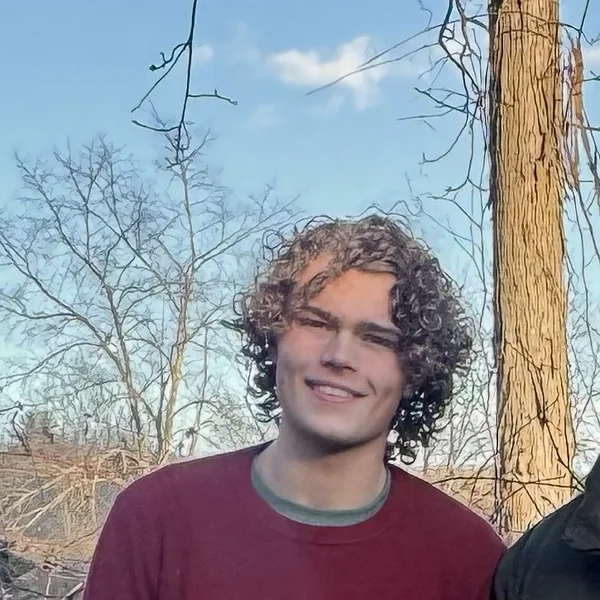
Zane Yarnell
Co-founder · product, frontend and distribution
19. Ran marketing for a business that grew to $1M a year, then designed and built Pawly's front end.
Why we started Pawly.
We tried other puppy apps first. They were lesson libraries: decent videos, the same plan for every dog, and a chat that didn't know our dogs.
What we wanted was what a great trainer gives you: someone who knows your dog, his week and his bad night, and tells you what to do next. Just without a trainer's price, and still there at 2 a.m.
Then we added what a trainer can't carry in their pocket: computer vision. Pawly checks a photo of his poop or a food label in seconds, and Jake's models are learning to read a training rep from one phone video.
We built it for ourselves first: for our six dogs, for Zane's wife and Jake's fiancée, and for every owner who has stood over a crate at midnight asking, is this normal?
- It knows your dog.
Ask anything. Pawly answers from his age, his logs and his plan, not from a generic article.
- A plan for his week.
Built around his age and what you're working on, with a check-in every night.
- Logging in one tap.
Potty, meals, naps and walks, so his pattern shows up on its own.
- Lessons from real trainers.
Short videos from trainers on YouTube, matched to the problem you have today.
- It can see.
A photo of his poop or a food label, checked in seconds. Or just ask whether he can eat that.
- There at 2 a.m., and honest about its limits.
If he cries in the night, it walks you through it. If it's a vet question, it says so.
Lesson apps
Good lessons, the same for every dog. They don't know what yours did today.
A personal trainer
Knows your dog. Charges by the session, and goes home at night.
Pawly
Knows your dog like a trainer does, and is there every day like an app.
Jake has been building since high school. Now he trains his own models.
He started by selling apps to small businesses and schools, then taught himself to code so he could stop paying the platform. In 2019 he built a robot to cook his breakfast; it worked until anything moved, and that's why he builds machines that see. He interned at GlaxoSmithKline as a college freshman, an internship that was extended to about eight months, then left college to build full-time.
Before Pawly he built AI systems for businesses through his studio, Salvo. He measures everything, and publishes the failed attempts next to the wins. Jake on LinkedIn
-
0.86
Keypoint score (mAP50) of his own dog-pose model
26 points on a dog from an ordinary phone video, scored on his validation set, at about 55 frames a second. It replaced a chain of off-the-shelf models that took nine minutes for a 47-second clip.
-
8th
Of about 1,000 in an AI red-teaming competition
He broke 28 of 30 model and behavior targets, covering all six scenarios.
-
17 of 19
Frontier models his own poker model outscored
An 8B model he trained came out ahead of 17 of 19 frontier models on the same solver-graded decisions.
-
7 of 10
AI makers with a model that fell for a fake safety story
He tested 13 models from 10 makers. A made-up, higher-priority safety story got a model from seven of them to put it ahead of its own user. He reported it through CERT/CC.
More of what he's built.
Most of it started because one job needed it. Where he measured it, the number is here.
- A study of 6.6 million AI decisions
Across 19 models, he tested whether a model's stated reasoning predicts what it actually does. Published as The Say/Do Gap.
AI research - Specialist poker models
Four small specialist models he trained scored 73.9% on the full 11,000-question PokerBench test, before the 8B model above.
Model training - Low-latency trading on Solana
He wrote the transactions himself and priced trades straight from on-chain balances, with no aggregator in the path. Across 1,817 trades on January 6–7, 40.2% landed in the same slot as the trade they followed. About $1.13 million in volume through one wallet.
Real-time systems · 2025–26 - A dog emotion model
Reads a dog's emotional state from a photo. It scored 0.867 on validation and 0.864 on held-out images. Bark and audio analysis sit beside it.
Pawly · Computer vision - Long-term memory for his AI agents
His own system that searches past conversations, code and documents and points back to the original source. More than 270,000 conversation passages indexed as of October 15.
Infrastructure - A legal research system
Built over 67,000 Iowa court opinions, with a router that maps a situation to the statutes that govern it.
Retrieval - Firmware forensics
He recovered several versions of Intel NPU firmware and compared them in Ghidra to trace a validation weakness that a later version fixed.
Security research - A plant rig with a robot arm
Camera, soil and climate sensors, a servo arm and remote GPU vision, tracking seedlings species by species. On a hand-counted dish of 41 baby oysters, his method cut the counting error from 11 to 4.
Hardware - 3D from a walk-through video
Ordinary footage turned into a connected 3D reconstruction of a room, replayable in the browser next to the source video.
Computer vision · October 2026 - His own voice dictation
Runs on his own machine. On his correction set, the model he chose cut word errors from 137 to 87 across 606 words.
Speech · October 2026
At Pawly, he built the engine.
It started with Lucas, his dog. An early version turned one iPhone video into the yard in 3D, his path through it and his top speed.
His bet: training is an interaction, not a pose. A sit means little without the cue, the marker, the reward and the timing between them, so he's building Pawly to read the owner and the dog together.
- The iPhone app's core, with native plugins for on-device vision and speech.
- The backend, and the coach that answers from your dog's own logs.
- A research server over 15 million real owner conversations and a cited research library.
Zane is 19, and he ships.
Before Pawly he ran marketing and social media for Telum Concepts, a law enforcement and civilian training company his dad co-founded in Pennsylvania. He also wrote and planned posts for creators and other people's accounts that reached tens of millions of views, grew one creator on X from about 3K to 30K followers in under a month, and did some creator work for TurboFlow. At Pawly he shares product with Jake and runs the frontend, distribution and marketing.
-
$1M
A year in revenue at Telum, from $1,000 per owner
He ran its marketing for three to four years as it grew, sold to customers in person, and worked on its acquisition of a majority stake in a second training company.
-
5
Dogs at home
Prince, his Shih-poo puppy, and his Labs, Marlin, Chief, Poppy and Ben.

This is Pawly.
The short version.
What people ask us first, answered plainly.
- Who builds what?
- Jake writes the code: the AI models, the backend and the native iPhone work. Zane designs and builds the front end and leads distribution. We set product direction together.
- How do you know each other?
- We met online more than three years ago.
- Are you full-time on Pawly?
- Yes, both of us.
- Why you two?
- Jake can measure a dog from one phone video. Zane has spent years getting products in front of people. And between us there are six dogs, one of them a puppy.
- Where is Pawly now?
- In beta on iPhone through TestFlight. Bootstrapped so far.
- How do we reach you?
- jake@pawlytechnologies.com and zaneypawly@proton.me
Come and try what we're building.
Pawly is in beta on iPhone. It isn't a vet and doesn't diagnose.